

- By Admin
- 19 Nov 2026
- HR Truck Driving Training
- 15 min read
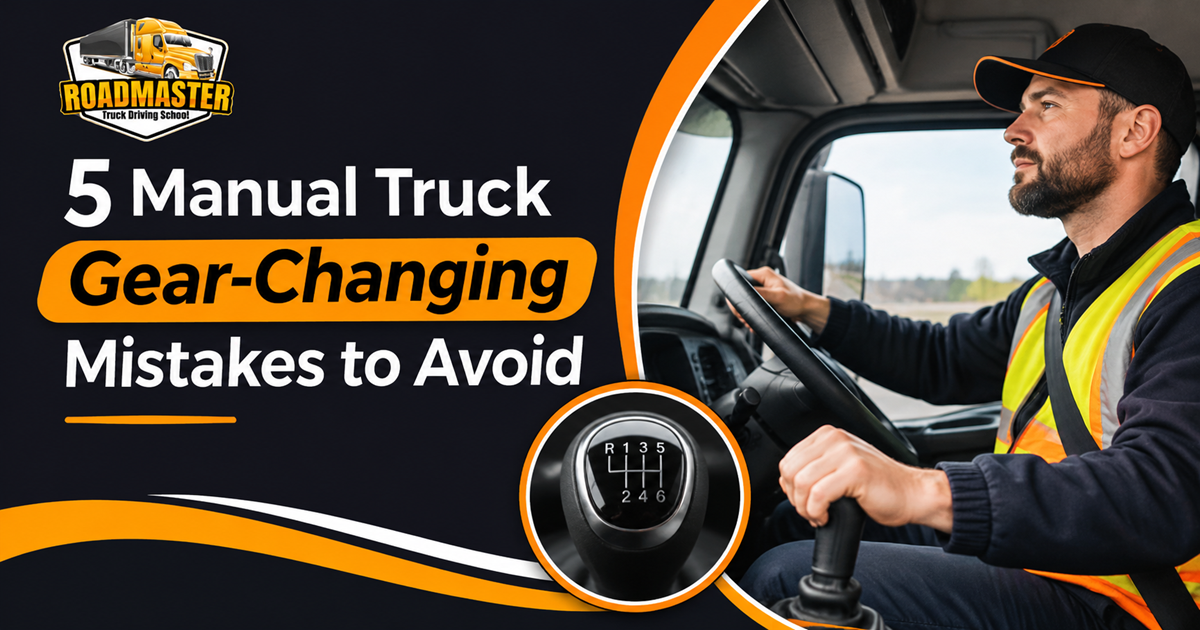
5 Common Manual Truck Gear-Changing Mistakes New HR Drivers Should Avoid
Learning to drive a manual truck can be challenging, even if you've spent years driving a manual car.
A heavy rigid truck has different handling characteristics, and changing gears requires you to coordinate the clutch, accelerator, gear lever and road speed.
The challenge can be even greater when you're learning to operate a Road Ranger gearbox.
If you're preparing for HR manual truck training in Perth, understanding common gear-changing mistakes can help you make better progress during your driving lessons.
Here are five mistakes to watch for, along with practical ways to work on them.
What's the Difference Between Synchromesh and Road Ranger Gearboxes?
Before discussing gear-changing mistakes, it's worth understanding the two main manual gearbox types used in heavy vehicle training.
Synchromesh Gearbox
A synchromesh transmission uses synchronising components inside the gearbox to assist with smooth gear changes.
This makes it easier to coordinate gear selection compared with a non-synchromesh transmission.
However, drivers still need to use the clutch correctly and select gears appropriate to the vehicle's speed and driving conditions.
Road Ranger Gearbox
Road Ranger is a commonly used term for a non-synchromesh heavy vehicle gearbox.
Unlike a synchromesh transmission, it does not have synchronisers to assist with matching gear speeds.
This means the driver must develop more precise timing and engine-speed coordination.
In Western Australian non-synchromesh practical assessments, double de-clutching is required.
Roadmaster Truck Driving School provides both HR Synchromesh Training and HR Road Ranger Training in Perth.
The right course depends on your experience, training requirements and the type of vehicle you want to operate.
1. Treating a Road Ranger Gearbox Like a Synchromesh
One common mistake is assuming that all manual truck gearboxes work in the same way.
A learner who has driven a manual car may expect a Road Ranger gearbox to respond similarly.
However, non-synchromesh transmissions require a different level of coordination.
Why Does This Cause Problems?
In a synchromesh gearbox, the synchronising components help match the speed of the gears during selection.
A Road Ranger gearbox does not provide that assistance.
If the driver attempts to change gears without the correct coordination, the gear may not engage smoothly.
Forcing the gear lever can also place unnecessary stress on transmission components.
How to Avoid This Mistake
Start by understanding how the specific gearbox operates.
During supervised training, your instructor can explain:
- The gearbox layout
- Appropriate gear selection
- Clutch coordination
- Engine-speed awareness
- The correct double de-clutching technique
- How to recognise an unsuccessful gear change
It's important to become familiar with the vehicle rather than assuming techniques from another truck will work exactly the same way.
2. Using the Clutch Incorrectly
Clutch control is another important part of manual truck driving.
New learners may release the clutch too suddenly, hold it incorrectly or struggle to coordinate clutch movement with gear selection.
In a Road Ranger truck, understanding the clutch system is particularly important.
What Is Double De-Clutching?
Double de-clutching is a gear-changing method used with non-synchromesh transmissions.
It involves coordinated clutch operation and engine-speed adjustment to make a gear change.
The correct sequence depends on the vehicle and should be learned through practical instruction.
Transport WA requires the double de-clutching method to be used when assessing a driver in a suitable non-synchromesh heavy vehicle.
What Is a Clutch Brake?
Some heavy vehicles have a clutch brake.
Its purpose is different from the main clutch's normal operation.
Where fitted, the clutch brake assists with gear engagement when the vehicle is stationary.
Incorrect clutch pedal operation while moving can cause unnecessary wear or damage.
Western Australia's heavy vehicle competency guidance specifically states that, where a clutch brake is fitted, the clutch should not be fully depressed during a moving gear change.
How to Avoid This Mistake
Ask your instructor to explain the clutch characteristics of the training vehicle.
During lessons, concentrate on coordinating the pedal movement with the gear change.
Don't rush the process or copy techniques from a vehicle with a different transmission.
If you're unsure about the clutch brake or gear-changing procedure, ask for a demonstration before attempting it.
3. Selecting the Wrong Gear for Your Speed and Driving Conditions
Another common problem is choosing a gear that doesn't suit the vehicle's current speed, engine operating range or driving conditions.
This can lead to poor vehicle response and unnecessary strain on the engine.
What Happens When the Gear Is Too High?
A gear that's too high for the vehicle's speed and conditions can cause the engine to labour.
For example, imagine approaching an uphill section while driving a loaded truck.
If the selected gear doesn't allow the engine to operate appropriately, the vehicle may struggle to maintain speed.
What Happens When the Gear Is Too Low?
An unsuitable lower gear can cause excessive engine revolutions or result in a harsh change if road speed and engine speed are not correctly matched.
Selecting gears correctly is part of maintaining smooth vehicle control.
How to Avoid This Mistake
Learn to recognise the relationship between road speed, engine speed and the selected gear.
During training, your instructor can help you understand:
- When an upshift is appropriate
- When a lower gear may be required
- How road gradients affect gear selection
- How vehicle load influences performance
- How to avoid engine labouring or excessive revving
The correct gear depends on the particular truck and the road conditions.
Don't rely on a fixed gear-change speed copied from another vehicle.
Why Does This Matter for HR Learners?
An HR truck may behave differently depending on its engine, gearbox, weight and load.
Understanding these differences helps you develop better control.
Roadmaster's manual HR training includes gear coordination and practical driving skills, allowing eligible learners to become familiar with the training vehicle's operation.
4. Changing Gears While Actively Steering Through a Turn
Gear changing and cornering both require attention and coordination.
When a learner attempts to manage an unfamiliar gearbox while actively steering through a corner, it can become more difficult to maintain accurate vehicle control.
Why Can This Be a Problem?
A heavy rigid truck requires careful positioning, particularly at intersections, roundabouts and narrow streets.
During a turn, the driver needs to consider road position, surrounding traffic and the vehicle's clearance.
An unnecessary gear change can interrupt smooth control.
Western Australia's heavy vehicle competency guidance states that gear changes should be completed primarily while travelling in a straight line.
The guidance also recognises that some changes during a turn may be necessary, provided the driver is not actively applying or removing steering and the change does not unsettle the vehicle.
How to Avoid This Mistake
Prepare for the corner before reaching it.
Your instructor can teach you how to coordinate braking and gear selection so the truck approaches the turn at an appropriate speed.
During training:
- Look ahead and identify the intersection early.
- Assess the traffic and road conditions.
- Reduce speed appropriately.
- Select the required gear at a suitable point.
- Maintain safe steering and vehicle control.
Avoid making unnecessary last-minute gear changes.
For related guidance, read Roadmaster's 5 Common Truck Turning Mistakes New HR Drivers Should Avoid.
5. Downshifting Too Late Before Hills or Changes in Road Speed
The final mistake is waiting too long to select an appropriate lower gear.
This can become a problem when approaching a steep descent, changing traffic conditions or another situation requiring a reduction in speed.
Why Does Downshifting Timing Matter?
A heavy vehicle's weight and operating conditions affect how it responds to braking and changes in speed.
If a driver waits until the last moment to select a lower gear, the change may become harder to complete smoothly.
An unsuitable gear can also reduce the driver's ability to manage vehicle speed effectively.
What About Driving Downhill?
Transport WA's heavy vehicle competency guidance requires an appropriate gear to be selected before descending a hill.
The chosen gear should help maintain a safe vehicle speed.
Drivers must also understand the correct use of their vehicle's braking systems.
For example, descending a hill in a loaded heavy vehicle requires greater attention to speed management than driving a passenger car on level ground.
How to Avoid This Mistake
Look ahead and recognise changing road conditions early.
During practical training, learn how to:
- Anticipate gradients and changes in traffic speed
- Reduce vehicle speed appropriately before downshifting
- Select a suitable gear for the conditions
- Coordinate braking and gear changes
- Maintain smooth control throughout the manoeuvre
The correct approach depends on the vehicle's braking system, transmission and operating conditions.
Do not attempt unfamiliar downhill driving techniques without proper instruction.
Quick Checklist: 5 Manual Truck Gear-Changing Mistakes
| Common mistake | What to focus on during training |
|---|---|
| Treating Road Ranger like Synchromesh | Learn the correct gearbox-specific technique |
| Incorrect clutch operation | Develop proper clutch coordination and understand the clutch brake |
| Selecting the wrong gear | Match the gear to speed, engine operation and road conditions |
| Changing gear while steering | Plan gear selection and maintain smooth vehicle control |
| Downshifting too late | Anticipate hills, corners and changes in traffic speed |
Use this checklist when reviewing your driving lessons with your instructor.
It is a learning aid, not a substitute for practical instruction.
Is Road Ranger Harder to Learn Than Synchromesh?
Many learners find Road Ranger more demanding because it requires closer attention to gear-change timing and engine-speed coordination.
Synchromesh transmissions use components that assist with gear engagement.
A non-synchromesh gearbox requires the driver to manage the relevant timing without that assistance.
However, the difficulty also depends on your previous driving experience.
Someone who has operated manual heavy vehicles for several years may find Road Ranger training easier than someone learning manual truck driving for the first time.
Which Gearbox Should You Choose?
Think about the vehicles you may need to operate.
If you're preparing for work involving heavy vehicles with non-synchromesh transmissions, Road Ranger training may be particularly relevant.
If you want to build manual truck driving skills with a synchromesh gearbox, that may be a suitable starting point.
Before booking, understand how the type of gearbox used in your assessment can affect your licence conditions.
Western Australia applies transmission-related restrictions to certain heavy vehicle licences.
You can read Roadmaster's existing guide: HR Automatic vs Synchromesh vs Road Ranger in WA.
Can Your Gearbox Choice Affect Your HR Licence Restrictions?
Yes.
In Western Australia, the gearbox used during a successful heavy vehicle practical driving assessment can affect the transmission types you're authorised to drive.
Transport WA explains that passing an assessment in an automatic or synchromesh vehicle can result in a licence restriction.
For eligible heavy vehicle classes, successfully completing the relevant assessment in a non-synchromesh manual vehicle can allow broader transmission privileges.
The exact restriction depends on the licence class and assessment circumstances.
Why Should You Check This Before Training?
Imagine obtaining an HR licence using an automatic truck.
Later, you receive a job opportunity involving a Road Ranger vehicle.
Your existing licence restriction may mean you need further assessment before you're authorised to drive that vehicle.
Understanding these restrictions before booking can help you choose training aligned with your intended work.
Always confirm the relevant licensing conditions with Transport WA.
How Can You Improve Your Manual Truck Gear-Changing Skills?
Improving gear-changing skills takes practice and feedback.
A few habits can help you get more from your training sessions.
Understand the Vehicle Before Driving
Ask your instructor to explain the transmission and clutch system before the lesson.
Learn the gearbox layout and understand which techniques apply to that particular truck.
Focus on Smooth Control
During practice, concentrate on coordinated movements and appropriate gear selection.
Don't rush a gear change because you're worried about being too slow.
Ask for Specific Feedback
After your training session, ask questions such as:
- Am I selecting the correct gear for the road speed?
- Is my clutch timing appropriate?
- Am I preparing early enough for downshifts?
- Which part of my gear-changing technique needs more practice?
This gives you something specific to work on during your next lesson.
Practise Under Proper Supervision
Heavy vehicle gear-changing techniques should be learned in a suitable training environment under the direction of an authorised instructor.
Avoid practising unfamiliar gearbox procedures independently on public roads.
HR Manual Truck Training at Roadmaster in Perth
Roadmaster Truck Driving School provides heavy vehicle training from Maddington, Perth.
Its HR course options include:
HR Automatic Training
For eligible learners preparing to operate heavy rigid vehicles with automatic transmissions.
HR Synchromesh Training
For eligible learners who want practical manual truck driving experience with a synchromesh gearbox.
Training covers clutch control, coordinated gear changes, road positioning and vehicle handling.
HR Road Ranger Training
For eligible learners seeking non-synchromesh manual truck driving skills.
The course focuses on Road Ranger gearbox familiarisation, coordinated shifting, clutch operation and practical assessment preparation.
Roadmaster also offers HC and MC training for eligible drivers considering further heavy vehicle licence upgrades.
The school works in partnership with Deltawest Training, RTO 40599, for relevant training and assessment arrangements.
Learn Manual Truck Driving with Roadmaster in Perth
Smooth gear changing is an important part of controlling a manual heavy vehicle.
Whether you're learning in a Synchromesh truck or preparing for Road Ranger training, understanding how the gearbox responds can help you develop better driving habits.
Roadmaster Truck Driving School offers practical HR manual truck training in Perth, with instruction covering gear changes, clutch control and heavy vehicle handling.
Ready to Develop Your Manual Truck Driving Skills?
Explore Roadmaster's HR training options and choose the course that suits your driving experience and licence requirements.
Roadmaster Truck Driving School
61 Clifford Street, Maddington WA 6109
Phone: 0451 370 037
Email: hello@roadmasterdrivingschool.com.au
Website: www.roadmasterdrivingschool.com.au
Frequently Asked Questions
Why is changing gears in a truck harder than in a car?
Manual heavy vehicles may have different gearbox designs, engine operating characteristics and clutch systems. Drivers must coordinate gear selection with road speed and vehicle conditions.
What is a Road Ranger gearbox?
Road Ranger commonly refers to a non-synchromesh heavy vehicle transmission. It requires the driver to coordinate gear changes without the assistance of synchronizers.
Can I learn Road Ranger without previous truck driving experience?
Your eligibility for HR training depends on Western Australia's licensing requirements. Roadmaster can help you understand the available training options and appropriate course for your experience.
How can I improve my truck gear-changing technique?
Practice with an instructor, learn the correct method for the gearbox, focus on clutch coordination and ask for feedback about gear selection and engine-speed management.
Does Roadmaster offer Road Ranger training in Perth?
Yes. Roadmaster Truck Driving School offers HR Road Ranger licence training from its Maddington location in Perth.