


- By Admin
- 07 Nov 2026
- truck reversing mistakes
- 15 min read
5 Common Truck Reversing Mistakes to Avoid During HC and MC Training
Reversing a truck and trailer combination can feel very different from reversing a car or a rigid truck.
You have a much longer vehicle to manage, limited visibility and a trailer that doesn't always move in the direction a beginner expects.
Even drivers with experience operating rigid trucks can find combination vehicle reversing challenging when they first start HC or MC training.
The skill takes practice, patience and a clear understanding of how the truck and trailer respond.
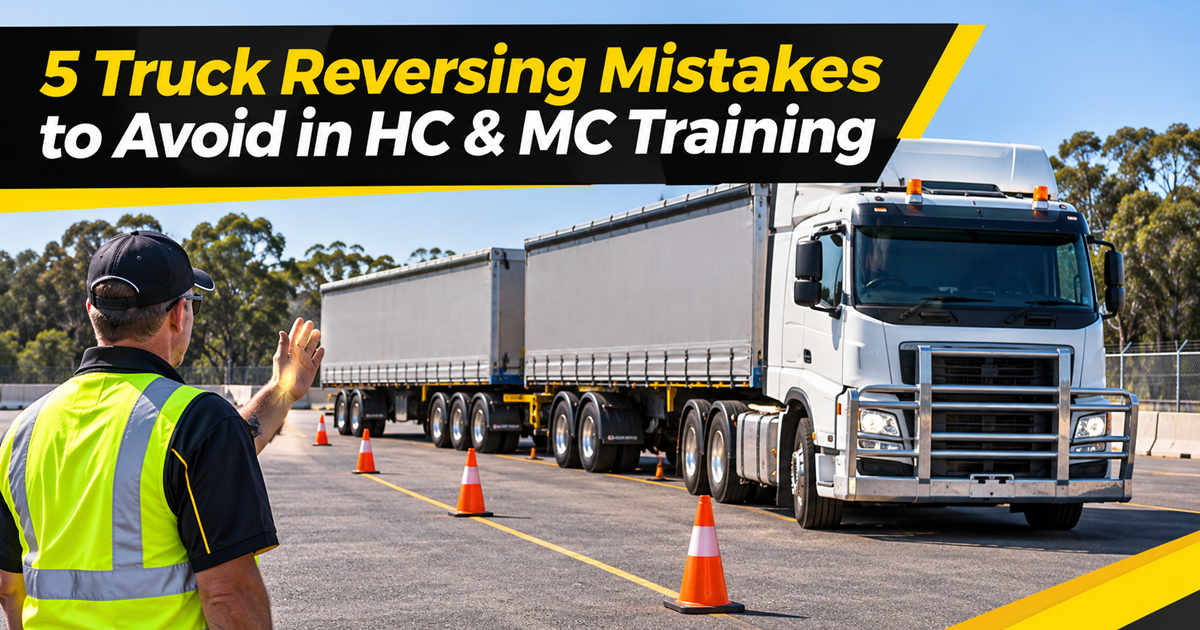
Five common truck reversing mistakes are starting from a poor position, failing to maintain observation, making excessive steering corrections, moving too quickly and continuing when the trailer's position is uncertain.
If you're preparing for Heavy Combination (HC) or Multi Combination (MC) training in Perth, here are five problems worth understanding and how to work on them safely.
1. Starting the Reversing Manoeuvre from the Wrong Position
One of the most common reversing problems begins before the truck even moves backwards.
A driver approaches the manoeuvre without considering how the truck and trailer should be positioned.
This can make the reverse more difficult than necessary.
For example, if you're preparing for a straight-line reverse and the combination is already poorly aligned, you may need additional steering corrections to bring it back into position.
Why Does Starting Position Matter?
A heavy vehicle combination has several dimensions to consider, including the length of the truck, trailer position and available clearance.
The initial position influences how much correction may be needed during the manoeuvre.
Starting at an unsuitable angle can also make it harder to maintain a clear view of the intended path.
How to Avoid This Mistake
Before beginning the reverse:
- Understand the intended manoeuvre.
- Observe the surrounding area.
- Confirm there is sufficient space.
- Check the truck and trailer alignment.
- Follow your instructor's guidance on the correct starting position.
During supervised training, your instructor can help you recognise how different starting positions affect the trailer's movement.
Practical tip: Don't rush into reverse gear simply because the vehicle has reached the starting area. Set up the manoeuvre properly before moving.
2. Relying on One Mirror and Missing Important Blind Spots
Mirrors are essential when reversing a heavy vehicle, but they cannot show everything around a truck and trailer.
A beginner may concentrate on one side of the vehicle while losing awareness of the opposite side.
This can become particularly dangerous when reversing near obstacles, parked vehicles or other people.
Why Is Observation So Important?
Heavy vehicles have significant blind spots.
When operating a combination vehicle, the view available through the mirrors can also change as the trailer moves.
A driver needs to monitor the vehicle's surroundings continuously, not just check once before reversing.
Western Australia's heavy combination assessment guidance requires drivers to maintain observation of the surrounding area during reversing manoeuvres.
How to Avoid This Mistake
During supervised practice:
- Adjust your mirrors correctly before driving.
- Follow a consistent observation routine.
- Monitor both sides of the vehicle.
- Remain alert to pedestrians, vehicles and obstacles.
- Stop if your view is inadequate or an area cannot be confirmed clear.
If your instructor directs you to stop and recheck the area, do so before continuing.
Never assume an obstacle has moved simply because it has disappeared from your mirror.
What About Reversing Cameras?
Cameras may provide additional visibility where fitted, but they don't remove blind spots or replace proper observation.
Drivers must follow the applicable training and assessment requirements rather than relying entirely on technology.
3. Making Too Many Steering Corrections
Steering a truck and trailer in reverse is different from steering a rigid vehicle.
When you're learning, it can be tempting to make a large steering adjustment as soon as the trailer begins moving away from the intended path.
The problem is that trailer movement may not respond in the way a beginner expects.
Repeated large adjustments can make it harder to regain the intended alignment.
Why Does This Happen?
Combination vehicles have articulation points.
The truck and trailer do not behave as one rigid unit.
As steering inputs change, the trailer's position can change relative to the towing vehicle.
For multi-combination vehicles, additional articulation points can make the movement more complex.
How to Avoid This Mistake
Start by learning how the particular combination responds under your instructor's supervision.
During training, focus on:
- Understanding the vehicle's articulation.
- Recognising how steering inputs affect trailer movement.
- Using smooth and controlled steering.
- Monitoring the trailer's response.
- Avoiding sudden or unnecessary corrections.
The correct steering technique depends on the combination and the manoeuvre.
That's why it's important to learn with a qualified instructor rather than relying on a single steering rule from an online video.
Practise Consistency Before Speed
When you're first learning, concentrate on making controlled movements and understanding the vehicle's response.
Your instructor can then help you improve accuracy as your skills develop.
Roadmaster provides HC Heavy Combination Training in Perth for eligible drivers who want to build practical combination vehicle skills.
4. Reversing Too Quickly
Another common mistake is trying to complete the manoeuvre faster than your skills allow.
Some learners worry about taking too long, particularly when they're preparing for an assessment.
However, moving too quickly can make it harder to monitor the trailer and respond appropriately to changes in its position.
Why Does Reversing Speed Matter?
A slow, controlled manoeuvre gives the driver an opportunity to observe the vehicle's movement and recognise when an adjustment is needed.
With a long combination vehicle, mistakes in positioning can become more difficult to correct if the vehicle continues moving.
The objective is to maintain safe and precise control.
How to Avoid This Mistake
During practical training:
- Use the appropriate gear for the manoeuvre.
- Maintain a safe, controlled speed.
- Avoid rushing steering adjustments.
- Keep monitoring your surroundings.
- Follow the instructor's guidance on vehicle control.
If you become unsure about the vehicle's position, stop safely and reassess the situation.
Don't accelerate in an attempt to finish the reverse sooner.
Does the MC Reversing Assessment Have a Time Limit?
Under Western Australia's published HC and MC assessment guidance, the MC reversing exercise involves a straight reverse of at least 70 metres, to be completed within seven minutes.
The guide also specifies conditions for adjustments and restarts.
These are assessment rules, not a reason to rush. Drivers must maintain the required safety and vehicle-control standards throughout the exercise.
Before your assessment, confirm the current criteria with the authorised training or assessment provider.
5. Continuing When the Trailer's Position Is Unclear
One of the most important driving habits is recognising when it's time to stop.
During reversing, a driver may lose track of a trailer's position or become uncertain about the available clearance.
Continuing without understanding the situation can create a serious risk of striking an object or another road user.
What Can Go Wrong?
For example, a driver might notice that the trailer is moving towards the edge of the intended reversing area.
Instead of stopping, they continue and attempt a large last-minute steering correction.
That decision may make the situation worse.
The safer approach is to stop when the position or available clearance is uncertain.
How to Avoid This Mistake
During supervised training, remember these principles:
Stop when unsure. Don't continue a manoeuvre without adequate visibility or confidence that the path is clear.
Reassess the position. Use the appropriate procedure to confirm the vehicle and surrounding area are safe.
Follow your instructor's directions. If you're practising in a training environment, your instructor can help you understand what went wrong.
Understand correction limits. During formal assessments, there may be rules governing permitted adjustments and restarts.
Never prioritise completing the manoeuvre over safety.
Reversing should always be carried out in a suitable location and under the correct supervision when you're learning.
HC vs MC Reversing: What's the Difference in WA?
HC and MC vehicles are both combination vehicles, but they involve different operating characteristics.
The reversing manoeuvres specified in Western Australia's published assessment guidance are also different.
| Assessment area | HC | MC |
|---|---|---|
| Vehicle type | Heavy Combination | Multi Combination |
| Published reverse exercise | Left or right reverse into a side street | Straight reverse of at least 70 metres |
| Permitted shunts or restarts | One | Two |
| Published time limit | Follow current assessment instructions | Seven minutes |
These details come from the WA Government's heavy and multi-combination practical assessment information sheet.
The exact training activities may differ from the formal assessment exercise.
You can review the official WA Heavy and Multi Combination Practical Driving Assessment Guide.
Always confirm the current requirements with your training provider before your assessment.
Quick Truck Reversing Checklist for Learners
Before and during a supervised reversing exercise, focus on the following.
| Area | What to remember |
|---|---|
| Starting position | Set up the truck and trailer for the intended manoeuvre |
| Observation | Check mirrors, surroundings and blind spots |
| Steering | Use controlled inputs appropriate to the vehicle |
| Speed | Reverse slowly enough to maintain safe control |
| Position awareness | Stop and reassess whenever the position is uncertain |
This is a general learning checklist. It does not replace practical instruction or the official assessment criteria.
Why Is Truck Reversing More Difficult with a Trailer?
When you reverse a rigid truck, the vehicle moves as one unit.
With a truck and trailer, the trailer moves relative to the towing vehicle.
The way it responds depends on several factors, including the vehicle configuration, trailer length, articulation and steering inputs.
In a multi-combination vehicle, managing more than one trailer can introduce further complexity.
This is why reversing skills developed in an HR truck don't automatically translate to an HC or MC combination.
Drivers upgrading their licences need opportunities to become familiar with the larger vehicle and learn the techniques appropriate to its configuration.
Roadmaster offers MC Multi Combination Training in Perth for eligible drivers preparing to operate multi-combination vehicles.
How Can You Improve Your Truck Reversing Skills?
Improvement comes from developing consistent habits and practising the correct techniques with appropriate supervision.
Ask Your Instructor for Specific Feedback
Instead of simply asking whether your reversing was good, ask which part of the manoeuvre needs improvement.
For example:
"Was my starting position suitable?"
"Did I maintain enough observation?"
"Was I making too many steering corrections?"
Specific feedback gives you something useful to work on during your next session.
Practise One Skill at a Time
If you're struggling with observation and alignment, focus on those areas before trying more difficult exercises.
Your instructor can adjust training activities to suit your experience and the vehicle you're learning in.
Understand the Vehicle You're Driving
Different truck and trailer combinations respond differently.
Don't assume a method learned in one vehicle will work exactly the same way in another.
Take time to become familiar with the vehicle's dimensions, articulation and visibility limitations.
Don't Practise in an Unsuitable Location
Reversing a heavy vehicle without the right supervision or environment can be dangerous.
Training should take place in an appropriate area under the direction of an authorised instructor, with other people and vehicles kept clear of the manoeuvre.
HC and MC Truck Driving Training at Roadmaster in Perth
Roadmaster Truck Driving School provides heavy vehicle licence training from its Maddington location in Perth, Western Australia.
Its courses include:
- HR Automatic Training
- HR Synchromesh Training
- HR Road Ranger Training
- HC Heavy Combination Training
- MC Multi Combination Training
The school offers practical instruction and one-on-one coaching options to help learners develop heavy vehicle driving skills.
For drivers progressing from HR to HC or MC, training provides an opportunity to become familiar with combination vehicle handling, observation and manoeuvring.
Roadmaster works in partnership with Deltawest Training, RTO 40599, for relevant nationally recognised training and assessment arrangements.
Actual assessment and licence outcomes depend on meeting the required standards and eligibility conditions.
You can explore Roadmaster's truck driving courses in Perth to compare the available training options.
Build Your Truck Driving Skills with Roadmaster
Reversing a heavy combination vehicle takes more than knowing how to steer.
It requires planning, observation, controlled movements and an understanding of the truck and trailer's position.
If you're preparing to upgrade your truck licence, structured training can help you identify mistakes and practise the skills relevant to your vehicle class.
Roadmaster Truck Driving School offers HR, HC and MC training in Perth, with practical instruction based at Maddington.
Ready to Upgrade Your Truck Licence?
Book Your Truck Driving Training
Roadmaster Truck Driving School
61 Clifford Street, Maddington WA 6109
Phone: 0451 370 037
Email: hello@roadmasterdrivingschool.com.au
Website: www.roadmasterdrivingschool.com.au
Disclaimer: This article provides general driver education only. Heavy vehicle reversing must be practised under appropriate supervision, following relevant road rules, safety requirements and instructor directions. Assessment procedures may change. Confirm current requirements with the relevant Western Australian licensing authority or approved training provider.
Frequently Asked Questions
Why is reversing a truck and trailer difficult?
Truck and trailer combinations have articulation points, a longer overall length and visibility limitations. Reversing requires drivers to understand how the trailer moves and maintain accurate vehicle control.
What is the most common mistake when reversing a truck?
There isn't one mistake that applies to every driver. Problems can include poor starting alignment, inadequate observation, excessive steering corrections and reversing too quickly.
How can I improve my HC truck reversing?
Practice under suitable instructor supervision, focus on observation and vehicle alignment, and ask for specific feedback about your steering and positioning.
Is MC truck reversing harder than HC reversing?
MC vehicles can be more complex because they may involve additional trailers and articulation points. The skills required depend on the vehicle combination and manoeuvre.
Does completing truck driving training guarantee a licence?
No. Applicants must meet the relevant eligibility, competency and assessment requirements. Training helps applicants prepare but does not guarantee a pass.